
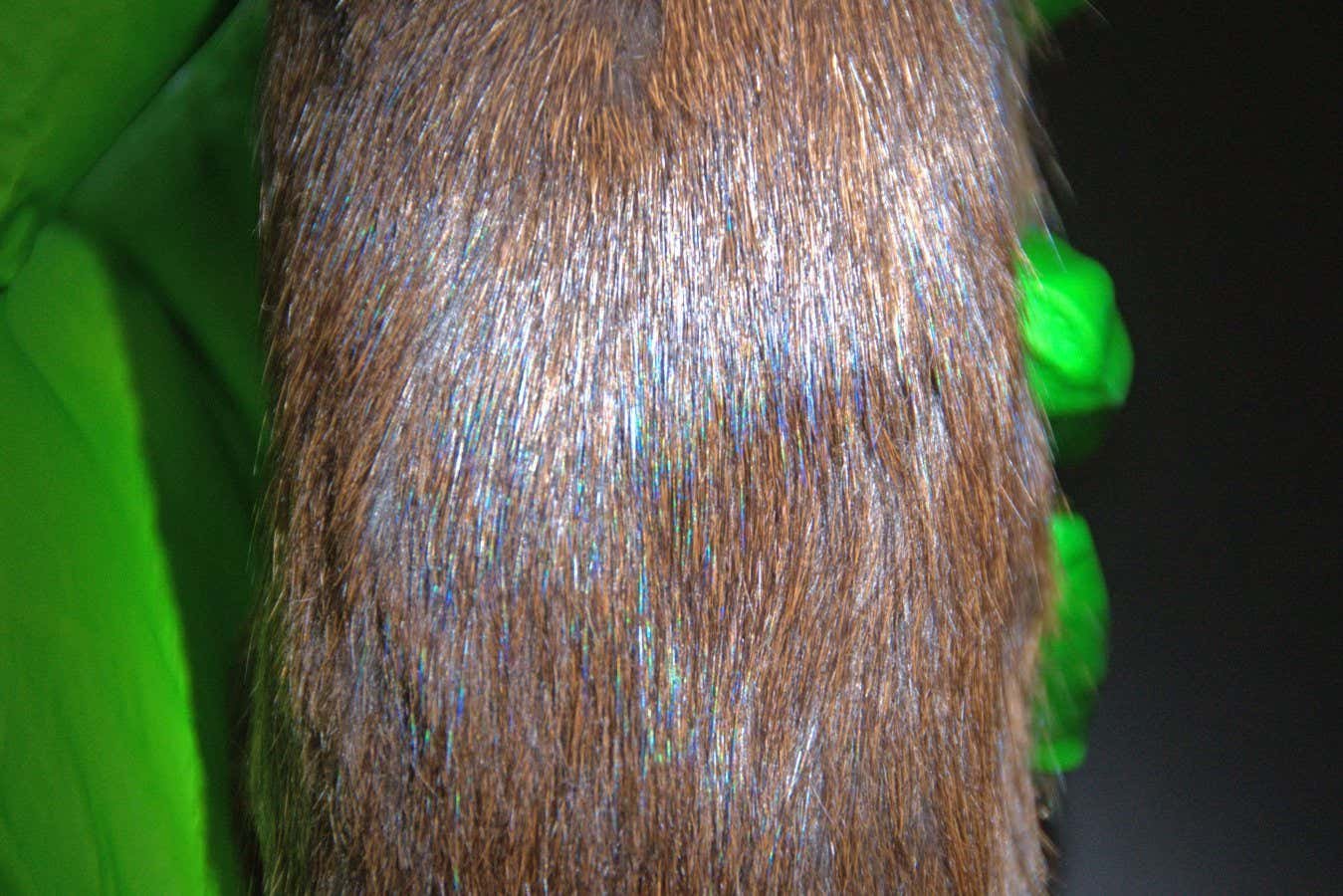

The tropical vlei rat has fur that shimmers with iridescent hues
Jessica Leigh Dobson
More than a dozen mammal species shimmer and glint purple and green, like precious opals. Their fur is iridescent, meaning its colour appears to change depending on the animal’s orientation relative to the viewer. The effect is similar to an oil slick’s colourful sheen, or the metallic dazzle of hummingbird feathers – and it’s more common among mammals than biologists thought.
Jessica Leigh Dobson at Ghent University in Belgium was studying colour in mammals using specimens at the Royal Museum for Central Africa, also in Belgium, when she noticed an electric blue glint on the fur of a tropical vlei rat (Otomys tropicalis).
“I immediately headed back to the office to see if it was documented anywhere, because everything I’d read up to then had been telling me [mammal] iridescence is only found in golden moles,” says Dobson. Golden moles are African burrowing mammals more closely related to aardvarks and elephants than true moles, their name derived from their tinsel-like hairs.
Dobson searched through the scientific literature and found casual mentions of other mammal species’ shiny fur dating as far back as the 1890s. Investigating further, she and her colleagues examined the fur on specimens of mammals that were associated with anecdotal reports of iridescence – or that were closely related to species with such reports. They used a light microscope to shine light on the fur at differing angles and analysed the wavelengths – and therefore the colours – of the light reflected off the hairs.
The analysis revealed that golden moles aren’t uniquely shimmery. An additional 14 mammal species have iridescent coats, including 10 rodents and the giant otter shrew (Potamogale velox), a semiaquatic predator that is neither otter nor shrew. Six of these species had never previously been considered iridescent in the scientific literature.
“It’s really nice to see such a detailed description of a previously under-described – and often undescribed – phenomenon,” says Beth Reinke at Northeastern Illinois University in the US, who wasn’t involved with the study.
When the researchers looked at the hairs of these iridescent mammals under a high-powered microscope, they found they were all unusually smooth, each made of a series of sub-parallel layers that were more highly compressed than the layers inside typical mammalian hair.
“Each layer bends light in slightly different ways and creates the shifting colours,” says Dobson.
The researchers think the shininess is probably a by-product of other hair-based adaptations. Most of these mammals are burrowing or swimming species, and the hairs’ smooth surfaces may help keep the fur clean in dirty or wet environments.
It is, however, possible the iridescence serves a function, perhaps for visual communication, as is the case in many birds, says Dobson. The new findings open the door to explore that possibility.
There could be plenty of new opportunities to do just that. In 2024, a newly discovered shrew species from Indonesia was described as having somewhat shiny fur. Dobson suspects there may be even more iridescent mammals out there, still unrecognised.
“Especially when you consider there’s about 2500 rodent species, and we looked at a tiny fraction of them.”
Topics: