
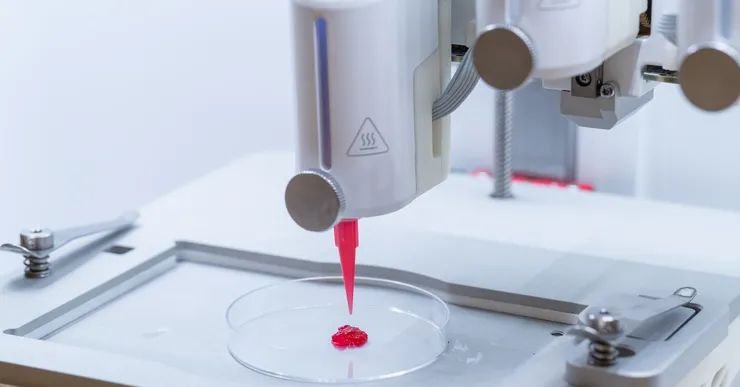

When treating severe burns and trauma, skin regeneration can be a matter of life or death. Extensive burns are usually treated by transplanting a thin layer of epidermis, the top layer of skin, from elsewhere on the body. However, this method not only leaves large scars, it also does not restore the skin to its original functional state. Unless the dermis, the layer below the epidermis, which contains blood vessels and nerves, is regenerated, it cannot be considered normal living skin.
Now, work by Swedish researchers may have brought medicine closer to being able to regenerate living skin. They have developed two types of 3D bioprinting techniques to artificially generate thick skin that is vascularized, meaning it contains blood vessels. One technique produces skin that is packed with cells, and the other produces arbitrarily shaped blood vessels in the tissue. The two technologies take different approaches to the same challenge. The approaches have been outlined in two studies published in the journal Advanced Healthcare Materials.
“The dermis is so complicated that we can’t grow it in a lab. We don’t even know what all its components are,” said Johan Junker, an associate professor at Linköping University and specialist in plastic surgery who lead this work, in a statement. “That’s why we, and many others, think that we could possibly transplant the building blocks and then let the body make the dermis itself.”
Junker and his team designed a bio-ink called “μInk” in which fibroblasts—cells that produce dermal components such as collagen, elastin, and hyaluronic acid—are cultured on the surface of small spongy gelatin grains and encased in a hyaluronic acid gel. By building up this ink three-dimensionally using a 3D printer, they were able to create a skin structure filled with high-density cells at will.
In a transplantation experiment using mice, the researchers confirmed that living cells grew inside tissue fragments made from this ink, secreting collagen and rebuilding the components of the dermis. New blood vessels also grew inside the graft, indicating that the conditions for long-term tissue fixation were met.
Blood vessels play an extremely important role in the construction of artificial tissues. No matter how many cells are cultured to create a tissue model, without blood vessels, oxygen and nutrients cannot be carried evenly to all cells. And without blood vessels, as the tissue structure grows, the cells in the center of the tissue die.
The research team has also created a technology called REFRESH (Rerouting of Free-Floating Suspended Hydrogel Filaments), which enables the flexible construction of blood vessels in artificial tissues by printing and arranging threads of hydrogel, a gels that 98 percent water. These threads are much tougher than ordinary gel materials and can maintain their shape even when tied or braided. Moreover, they also have shape-memory properties that allow them to return to their original shape even when crushed.